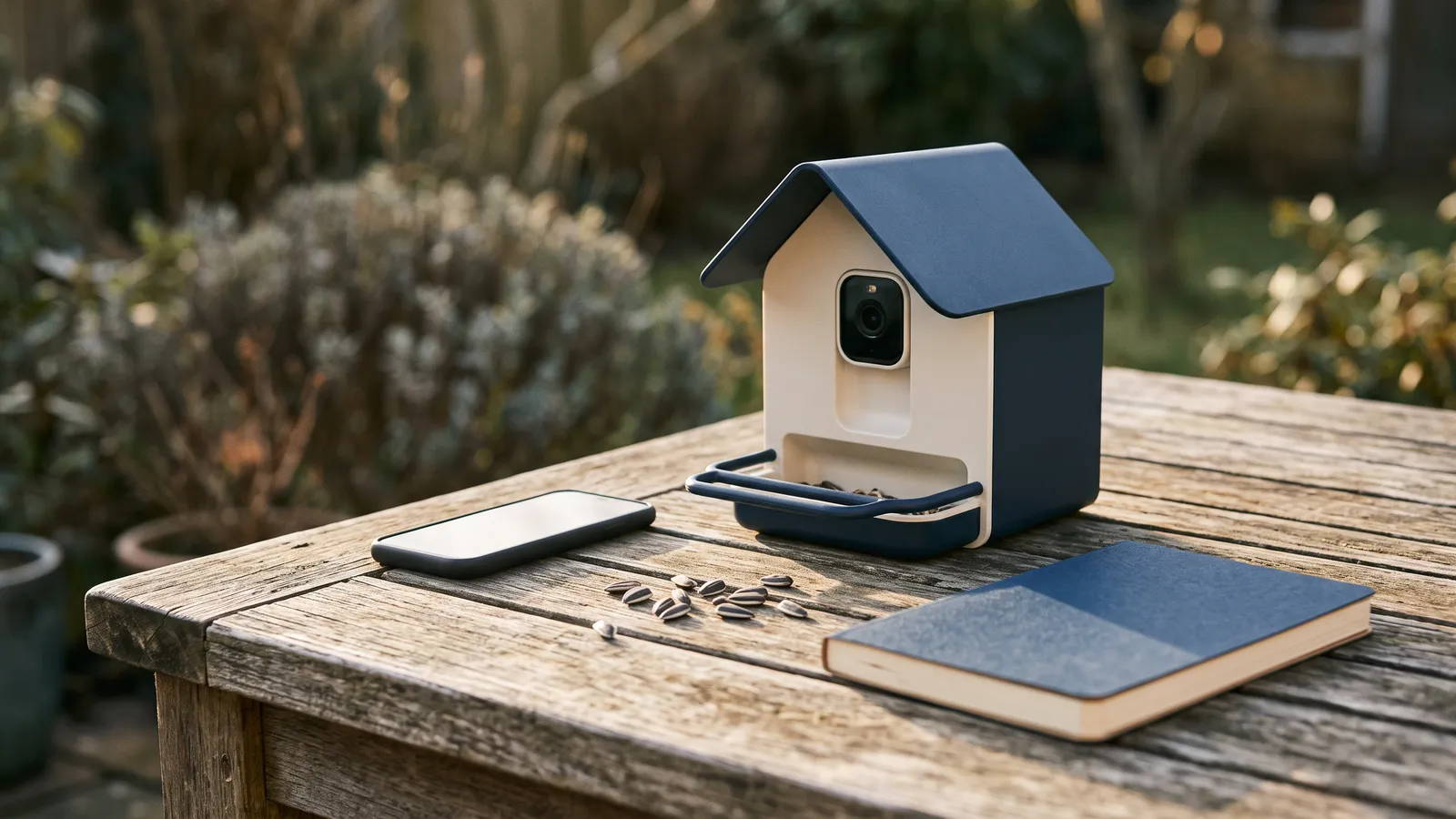
Where to hang a bird feeder camera decides almost everything that comes after. A spot with weak Wi-Fi gives you missed alerts. A shady branch turns a solar feeder into one you charge by hand. A feeder in front of a big window can cost birds their lives. And a feeder squirrels can reach becomes a squirrel camera.
The good news: the right spot is easy to find with your phone, a sunny afternoon and a short checklist. This guide pulls together what the feeder makers say in their own documentation and what the Cornell Lab of Ornithology, the American Bird Conservancy and state wildlife agencies recommend.
Start with the Wi-Fi signal, not the view
A feeder camera is a Wi-Fi camera first. Bird Buddy says in its help center that its feeders have no local storage: without a connection, nothing reaches your phone. Other brands can record to a microSD card, but alerts and live view still need the network.
Most models in our best bird feeder camera comparison connect only on the 2.4 GHz band. That is less of a limit than it sounds. Bird Buddy notes that 2.4 GHz usually reaches farther and passes through walls better than 5 GHz, which helps outdoors. A few models, such as the Birdfy Metal 2K, accept both bands, which helps when your router runs a 5 GHz-only network.
How to check a spot before you drill or dig:
- Stand where the feeder will hang, with your phone. Bird Buddy's rule of thumb is simple: if your phone can hold a Wi-Fi connection there, the feeder should too.
- Turn off mobile data so the phone cannot fall back on the cellular network, then stream a video for a few minutes. Stalls are a warning.
- Look for a stable link, not full bars. Bird Buddy says its feeders work normally on a Weak or Medium reading as long as the connection holds.
- Check again after setup. Birdfy's app has a Wi-Fi analysis tool in the device settings, and Birdfy recommends a spot with a strong signal.
If the best birding spot sits at the edge of your coverage, a mesh node or outdoor extender near the yard side of the house is usually cheaper than fighting dropouts. Weak connections are a recurring complaint in owner feedback across brands, so this step is worth ten minutes.
Give the solar panel real sun, in winter too
Solar panels on feeder cameras are small. Birdfy states plainly that its panel is designed to keep a full battery topped up, not to bring an empty one back. Charge the camera from a wall outlet first, then let the sun maintain it.
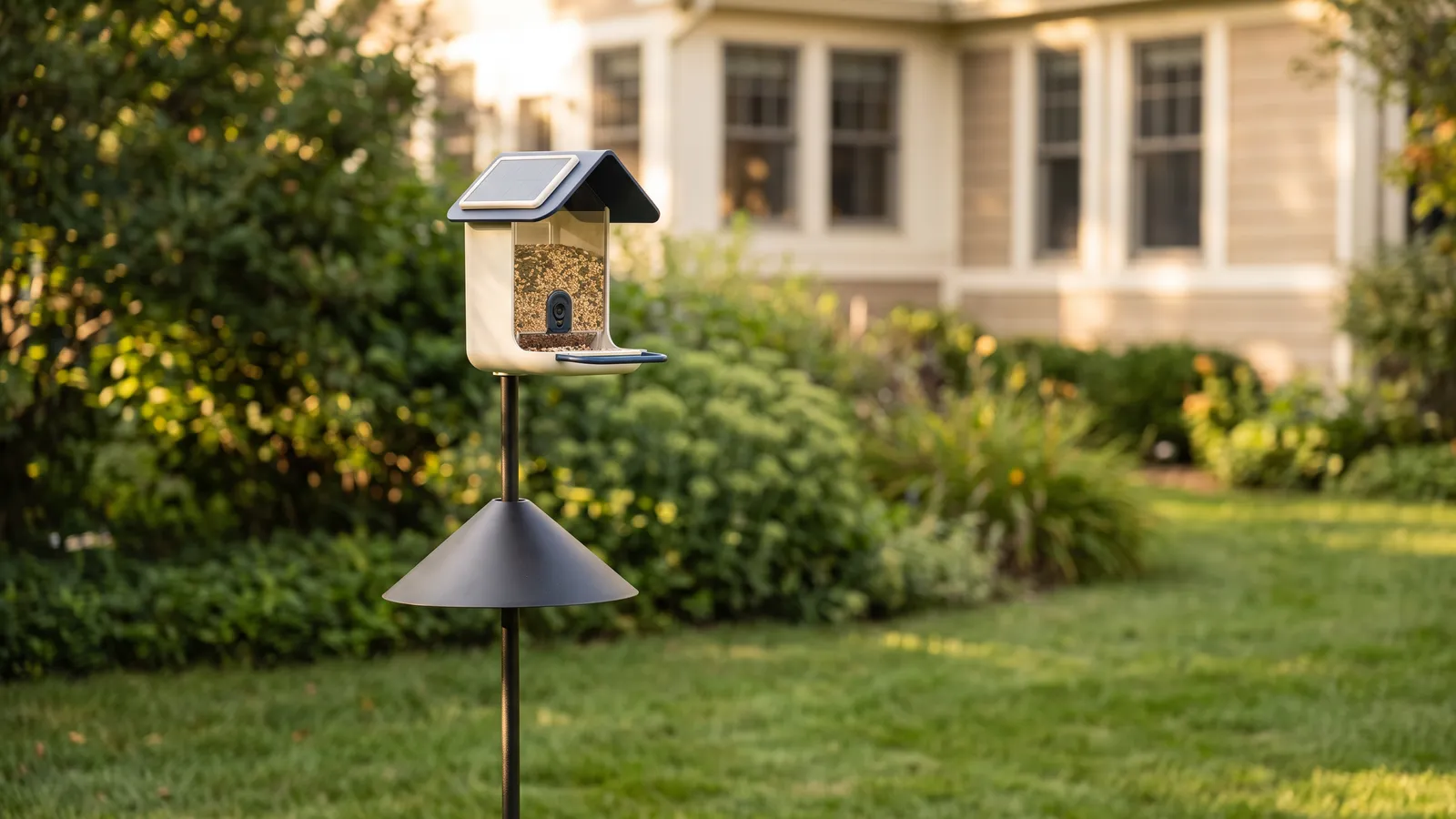
Orientation comes next. In the Northern Hemisphere, Bird Buddy advises pointing the panel south for the most consistent sunlight. A feeder that hangs freely can turn in the wind, so a pole mount or a fixed bracket keeps the panel facing the right way.
Then think about December, not July. Bird Buddy's winter guidance (October 2026) explains that from about October through February the sun sits lower, so a spot that got full afternoon sun in summer may now be shaded by a roof, a fence or a neighbor's house. Its advice:
- Check the panel at midday and again in the afternoon. If shadows cover it, move the feeder a few feet or turn the panel south.
- After snowfall, brush the panel clear with a soft brush or a gloved hand. Do not scrape ice; let it melt.
- Expect shorter runtime in deep cold. Bird Buddy says its camera keeps working down to about -20°F but drains faster. Let a cold camera warm up indoors before charging it.
If your feeder spot is shady, an external panel solves the problem. It can sit on a sunnier post or wall while the feeder stays where the birds are. Birdfy notes that higher-wattage panels charge faster and recommends its chew-proof cable for yards with squirrels or raccoons.
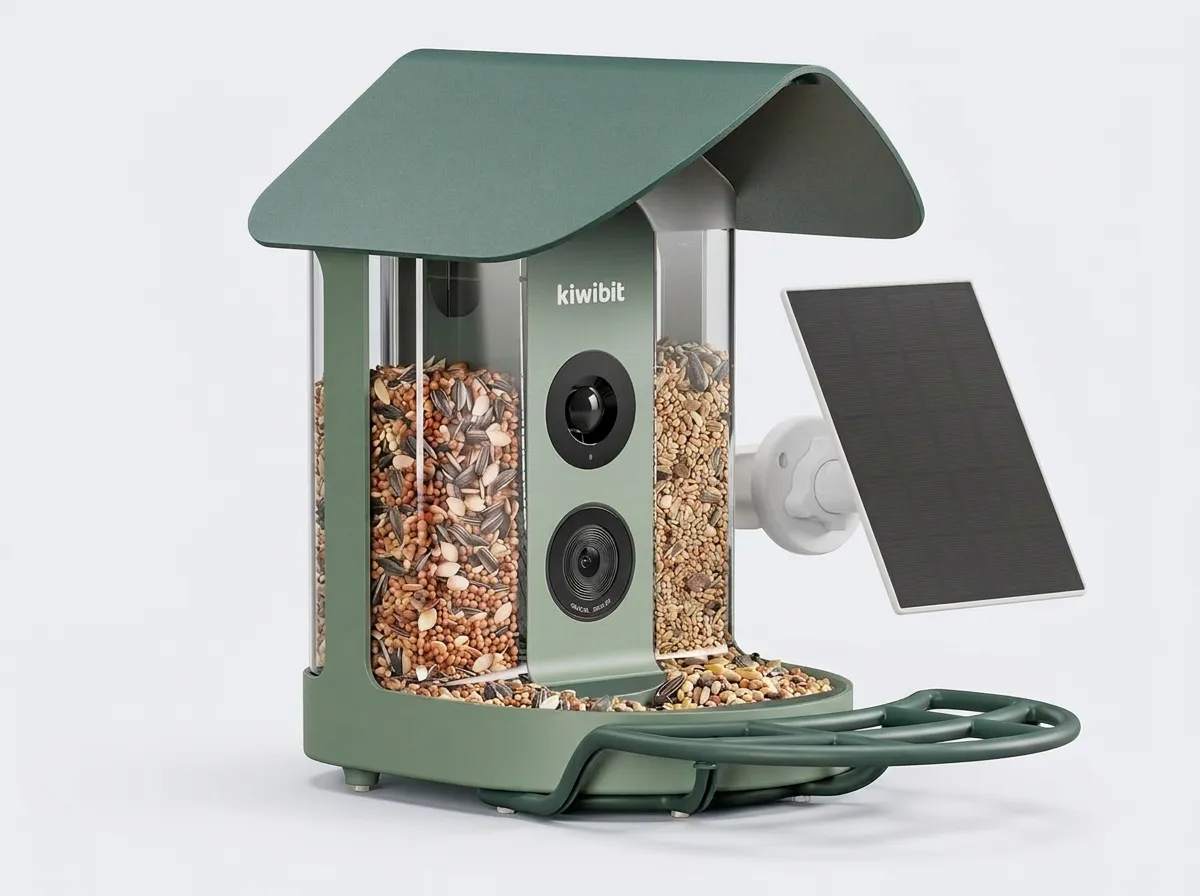
Kiwibit Feeder with Solar Panel
Availability checked on November 11, 2026. Prices change often: the button below shows today’s price and seller offers.
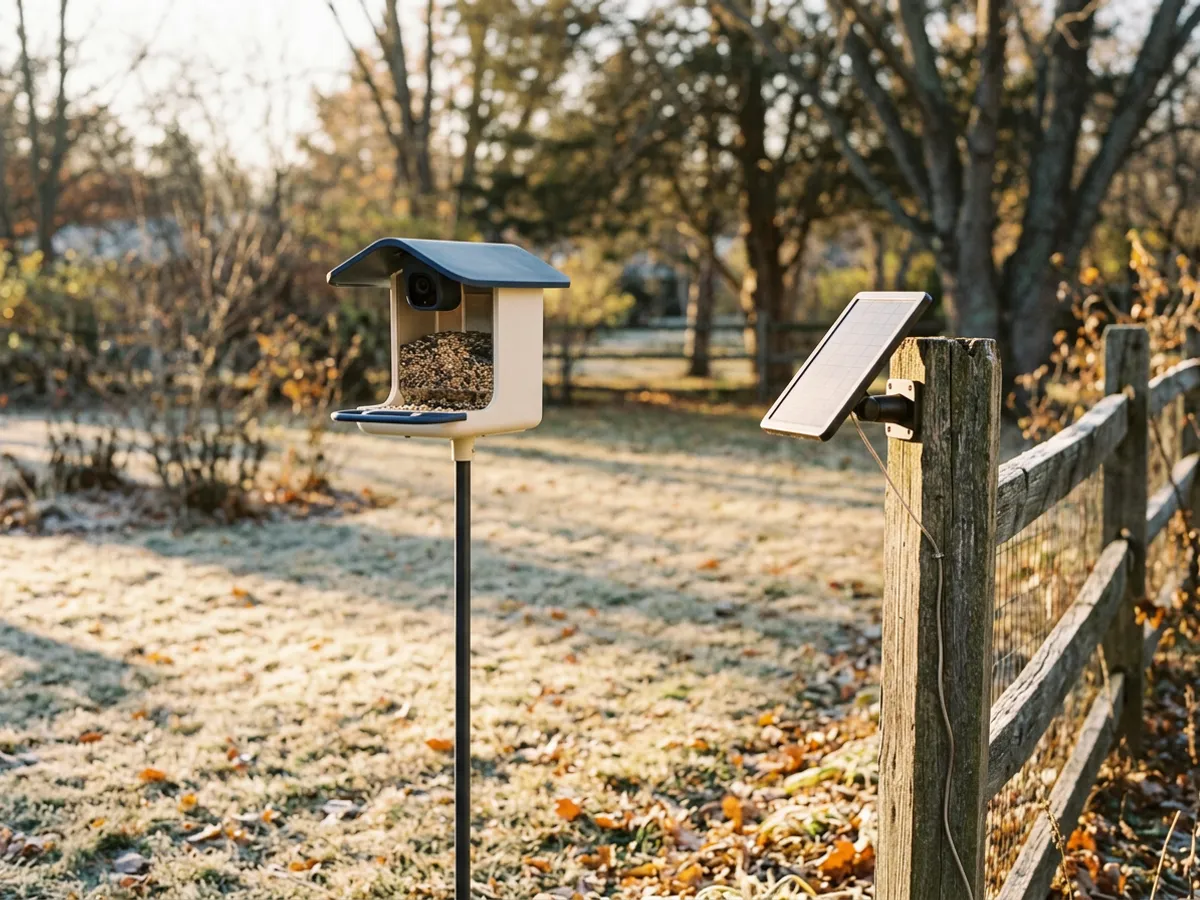
Keep birds safe: windows, squirrels and predators
Windows: very close, or treated glass
Glass kills more birds than most people expect. The American Bird Conservancy puts the toll at more than one billion birds a year in the United States. All About Birds, from the Cornell Lab, cites up to about one billion, based on a 2014 study. Birds hit windows because they see reflected sky and trees, or see straight through the glass to plants on the other side.
You will often read a distance rule: feeders within 3 feet of a window, or more than 10 or 30 feet away. The Cornell Lab's own FeederWatch handbook gives the 3-foot version, reasoning that a bird leaving a feeder that close cannot build up dangerous speed. A more recent All About Birds article (May 2025) is more cautious. It quotes a glass-collision specialist who says past distance rules are no longer thought to be valid: if windows are near a feeder, make them bird-friendly and do not count on distance alone.
The sources do agree on what works:
- Treat the outside of the glass. The American Bird Conservancy recommends markings at least a quarter inch wide, spaced no more than 2 inches apart for best results; gaps of 4 inches can let small songbirds and hummingbirds through.
- Use exterior screens. Insect screens on the outside of the window cut reflections and help prevent collisions.
- Treat the windows that face the feeder first. ABC lists windows across from feeders and bird baths as the priority.
- Skip the lone hawk silhouette. All About Birds notes it does little on its own.
For a camera feeder, that usually means one of two layouts: a feeder very close to a treated window, or a feeder out in the yard with the facing windows treated anyway.
Squirrels, hawks and cats
A camera feeder is a costly thing to lose to a squirrel. The Cornell Lab's FeederWatch handbook recommends a baffle below a pole-mounted feeder and, when squirrels jump from above, a tilting baffle at least 18 inches across placed over the feeder. Birdfy's setup guide for one of its feeders recommends a pole at least 1.5 meters high (about 5 feet) with a squirrel baffle.
Cover is a balancing act. FeederWatch suggests about 10 feet between the feeder and shrubs or trees as a compromise: close enough for small birds to escape a hawk, far enough that cats cannot ambush from the bushes. The same handbook notes that cats kill hundreds of millions of birds a year and strongly recommends keeping pet cats indoors. If a hawk starts hunting at your feeder and that bothers you, FeederWatch suggests taking the feeder down for a few days so the hawk moves on.
Chew-resistant bodies help too. Metal feeders such as the Birdfy Metal 2K are built for yards where squirrels test everything.
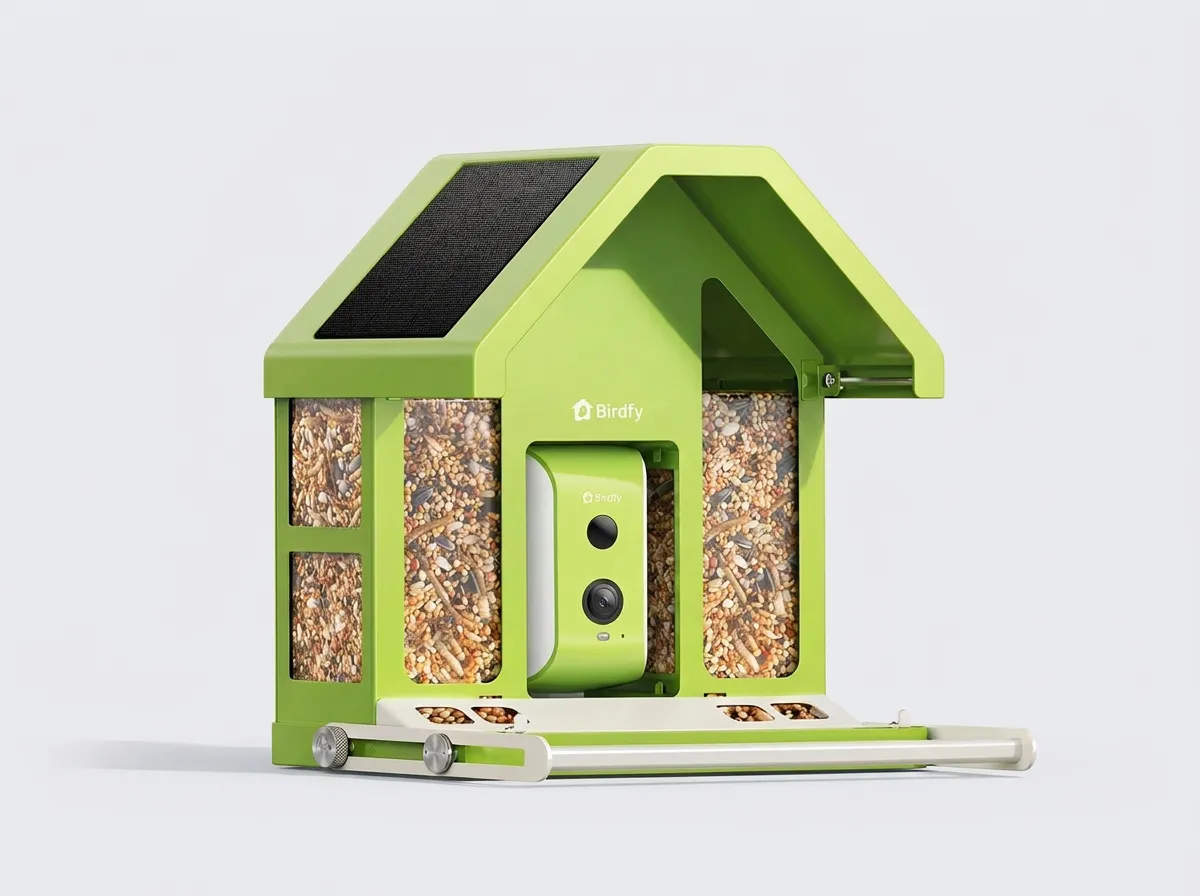
Birdfy Metal 2K
Availability checked on November 11, 2026. Prices change often: the button below shows today’s price and seller offers.
Keep it clean: disease, bird flu and current guidance
A camera makes sick birds easier to spot, and feeders can spread disease when birds crowd together. Here is what official sources say.
Cleaning routine. All About Birds recommends cleaning seed feeders about once every two weeks, more often in heavy use, wet weather, or when salmonella has been reported nearby. Scrub them, soak them in a bleach solution of no more than 1 part bleach to 9 parts water, rinse, and let them dry before refilling. Clean up the hulls and waste on the ground below too. On a camera feeder, remove the camera module and follow the maker's instructions before you wash the hopper. Bird Buddy's winter guide says to wipe the lens with a soft microfiber cloth, with no hot water, de-icing spray or anything abrasive.
When sick birds show up. Project FeederWatch lists the diseases most often seen at feeders: house finch eye disease (crusty, swollen eyes), avian pox, salmonellosis and avian influenza. Its advice is to remove the feeders a sick bird is using for a couple of weeks and clean them and the area thoroughly. Local agencies can go further. In August 2026, the Wyoming Game and Fish Department asked residents of part of Lander to take seed feeders down for four weeks during an outbreak of eye disease in house finches, to clean with a 10 percent bleach solution, and to wear gloves.
Bird flu. The All About Birds update of January 2026 says there is no official recommendation to take down feeders unless you also keep domestic poultry, citing the National Wildlife Disease Program. USDA APHIS advises poultry owners to remove wild bird feeders or keep them well away from their flock. The Utah Division of Wildlife Resources says the same as of February 2026 and notes that songbirds are usually not affected by highly pathogenic avian influenza. Guidance can change quickly, so follow your state wildlife agency if its advice differs.
Placement checklist
Run through this list before you commit to a spot:
| Check | What to look for |
|---|---|
| Wi-Fi | Phone streams video smoothly at the exact spot, mobile data off |
| Wi-Fi band | Router broadcasts 2.4 GHz, unless the feeder also supports 5 GHz |
| Sun | Panel faces south; direct sun at midday and in the afternoon, checked again in late fall |
| Battery | Camera fully charged from a wall outlet before relying on solar |
| Windows | Feeder very close to a window, and facing windows treated outside |
| Height and baffle | Pole mount about 5 feet up, with a baffle against climbing squirrels |
| Cover | Shrubs or trees about 10 feet away, no hiding spot for cats right next to the feeder |
| Access | Easy to reach for refills, cleaning and charging |
| Hygiene | Cleaning every two weeks on the calendar, ground below kept clear |
Once the spot is set, the next question is often what the app costs after the trial. Our guide to bird feeder camera subscriptions covers what stays free on each brand. For model-by-model details, see the Bird Buddy brand page or our Kiwibit Feeder 2 Mini review.
Frequently asked questions
No brand gives a fixed distance, because walls, siding and trees change the range. Bird Buddy's test is the most practical: if your phone holds a stable Wi-Fi connection at the exact spot, the feeder should too. A 2.4 GHz network usually reaches farther outdoors than 5 GHz.

Our guides rely on published sources: studies, official bodies, hobby clubs and manufacturer documentation.
- Birdbuddy Help Center: Connectivity and Wi-Fi requirements; Birdbuddy Nook assembly and mounting
- Birdbuddy blog: getting your Birdbuddy ready for winter (October 2026)
- Birdfy Help Center: Solar Panel Tips; Feeder Bamboo A getting started
- All About Birds (Cornell Lab of Ornithology): window collisions, feeder cleaning, avian influenza and feeders
- American Bird Conservancy: Solutions for Homes
- Project FeederWatch (Cornell Lab): Sick Birds and Bird Diseases; FeederWatch Handbook
- Wyoming Game and Fish Department (August 2026) and Utah Division of Wildlife Resources (February 2026)