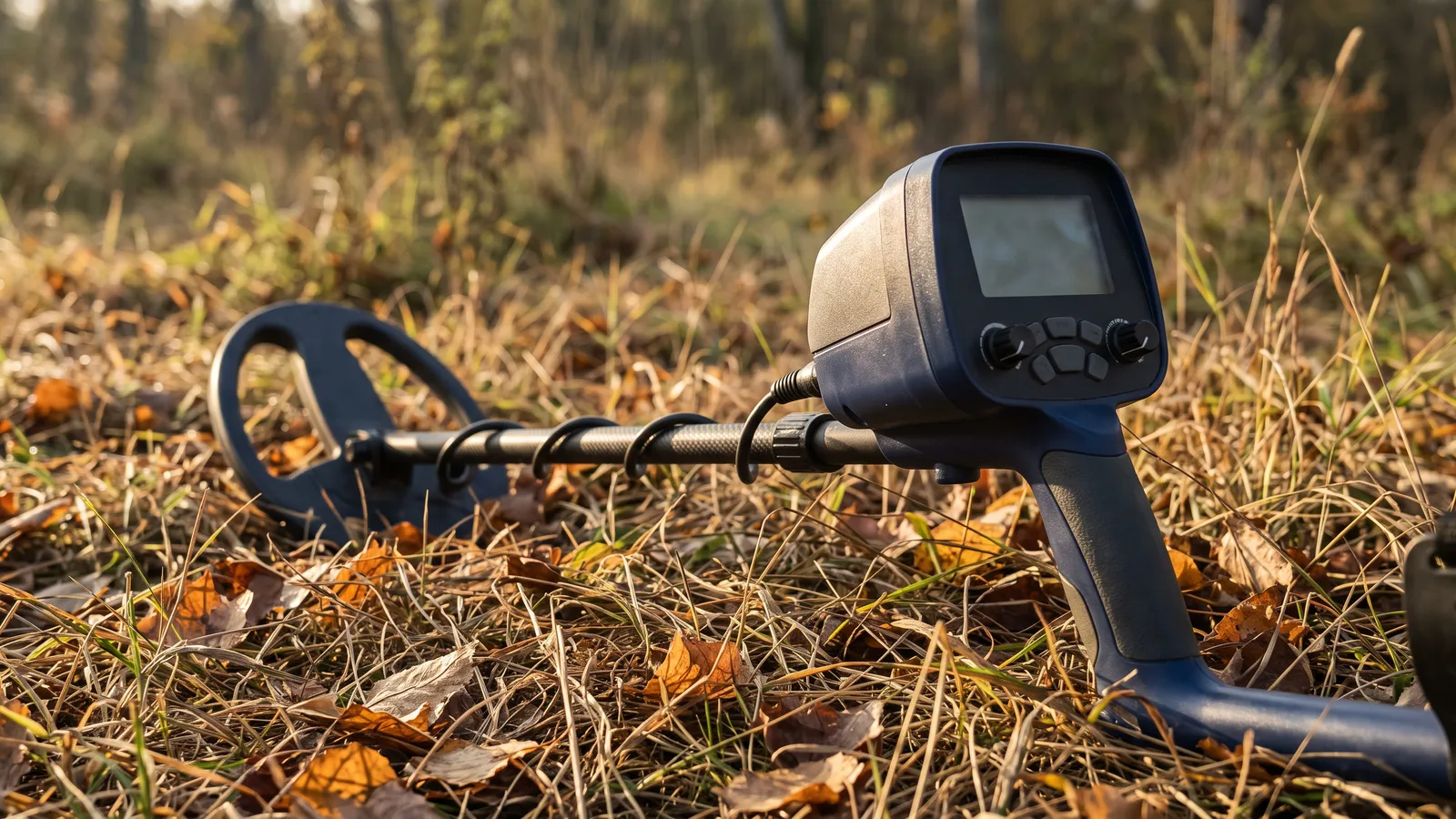
Metal detector basics come down to a handful of words that every spec sheet throws at you: VLF, kHz, multi-frequency, target ID, discrimination, Double-D, ground balance. Each one answers a simple question. How deep and how small? What is it likely to be? How much does the soil get in the way? This guide translates them into plain English, using manufacturer documentation from Garrett, Minelab and First Texas (the maker of Bounty Hunter), and real models as examples.
How a VLF detector works, and what kHz means
Many hobby detectors, such as the Bounty Hunter Tracker IV that First Texas lists as VLF, are very low frequency machines. According to Minelab, the search coil creates a magnetic field that reaches into the ground, and metal objects send back a response that the electronics pick up. The frequency, measured in kilohertz (kHz), is how many times per second that field cycles.
Frequency shapes what a detector is good at. Minelab's own rule of thumb:
- Lower frequencies penetrate deeper and suit larger, highly conductive targets such as silver coins and big relics, but they are less sensitive to small, low-conductivity targets. Minelab puts "low" at around 5 to 10 kHz.
- Higher frequencies are more sensitive to small or thin targets, such as small gold nuggets and fine gold jewelry, but they do not reach as deep. That is why, as Minelab notes, dedicated gold detectors run at higher frequencies while coin and treasure detectors run lower.
Some real examples from the spec sheets: the Bounty Hunter Tracker IV runs at 6.6 kHz, and the Garrett ACE 300 at 8 kHz. Both sit in the classic coin-and-relic range. The ACE 300 also offers a small frequency adjust, which Garrett says is there to reduce interference from electrical sources or other detectors, not to change what it finds.
Single, selectable or simultaneous multi-frequency
Three designs share the market:
- Single frequency. One fixed frequency, like the Tracker IV and the ACE 300. Garrett describes these as working fine in simple conditions but falling short when the ground or the targets get demanding.
- Selectable frequency. You pick one frequency at a time. The Minelab X-Terra Pro offers 5, 10 or 15 kHz in its Park and Field modes and 8 kHz in Beach mode, according to Minelab's tech specs. You get flexibility, but still one frequency per sweep.
- Simultaneous multi-frequency. The detector transmits several frequencies at the same time and combines the results. Minelab's version is called Multi-IQ, used in the Vanquish 340.
What does simultaneous multi-frequency buy you? These are manufacturer claims, and both brands sell such machines. Minelab says Multi-IQ is more accurate across a wider variety of targets and more reliable in mineralized ground and wet sand, with no frequency to choose. Garrett says wet salt sand pushes single-frequency detectors into constant false signals, and that multi-frequency designs can filter out the salt signal. The practical takeaway: if you plan to hunt wet beach sand often, multi-frequency is worth a look; for dry parks and yards, a good single-frequency machine remains a sound start.
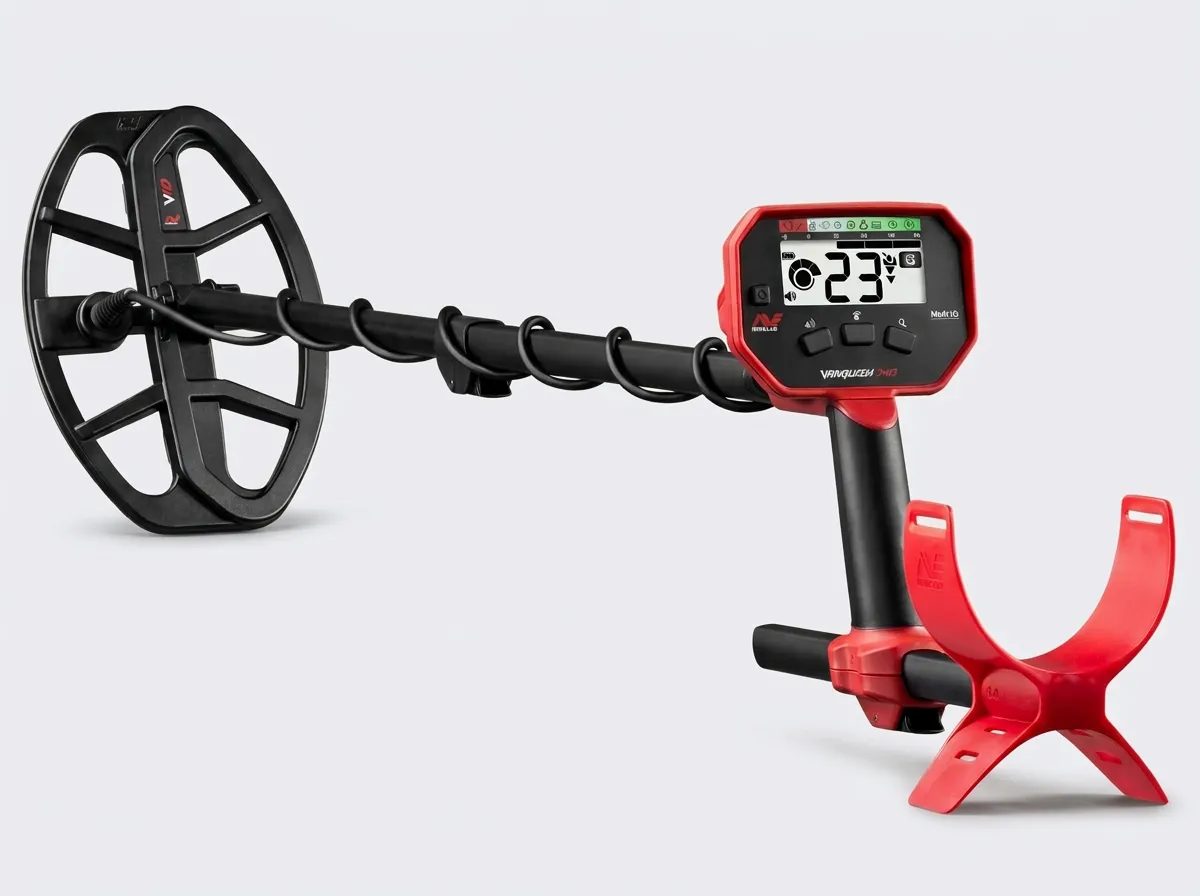
Minelab Vanquish 340
Availability checked on November 11, 2026. Prices change often: the button below shows today’s price and seller offers.
Target ID, discrimination and notch: reading the signal
A beep tells you something metal is there. Target ID tries to tell you what. Minelab explains that its detectors measure two properties: how ferrous a target is (how much iron it contains) and how well it conducts. Iron tends to be trash, and foil or nails conduct differently from coins and rings, so the detector can make an educated guess.
Brands show that guess on different scales, and the numbers are not interchangeable:
- Garrett ACE 300: a 0 to 99 numeric scale that, according to Garrett, identifies a target's conductivity. Its Iron Resolution feature adds finer control over how much iron to reject, which Garrett says helps where good targets are masked by iron trash.
- Minelab: iron reads as negative numbers. The Vanquish 340 runs from -19 to 0 for ferrous targets and 1 to 40 for non-ferrous ones; the X-Terra Pro stretches the non-ferrous side to 99.
- Bounty Hunter Tracker IV: no numeric ID at all, according to First Texas, just an analog meter and two-tone audio.
Discrimination is the filter built on that ID: it tells the detector to stay quiet on certain ranges, usually iron. Notch is a finer version that rejects one band, say pull tabs, while still accepting targets on either side. The ACE 300 has adjustable notch discrimination, and the X-Terra Pro has 30 discrimination segments, according to the makers. A word of caution that follows from how ID works: it is an estimate based on conductivity, so a small piece of jewelry and a piece of aluminum trash can read close to each other, and notching out trash can also hide a good target. Beginners often learn more by digging most signals at first.
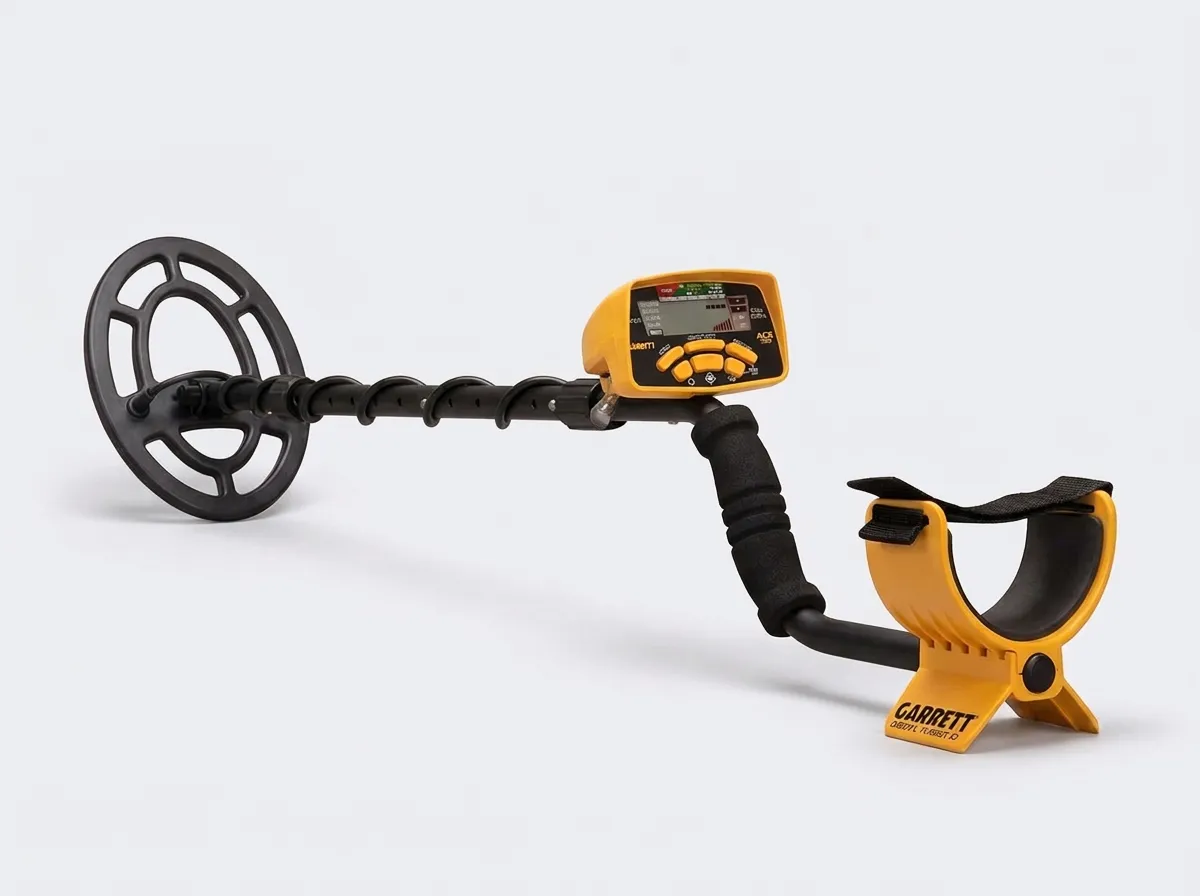
Garrett ACE 300
Availability checked on November 11, 2026. Prices change often: the button below shows today’s price and seller offers.
Coils, ground balance and water
Concentric or Double-D?
The search coil is the round or elliptical plate you sweep. Minelab's FAQ describes the two common windings:
- Concentric coils have an inner and an outer winding and a cone-shaped detection field. They pinpoint accurately but tend to be noisier in highly mineralized ground and need more overlap between sweeps. The ACE 300's 7 x 10 in coil is concentric.
- Double-D (DD) coils produce a blade-shaped field that covers the ground more evenly, and Minelab says they handle ground balancing better. The Vanquish 340 and X-Terra Pro use DD coils.
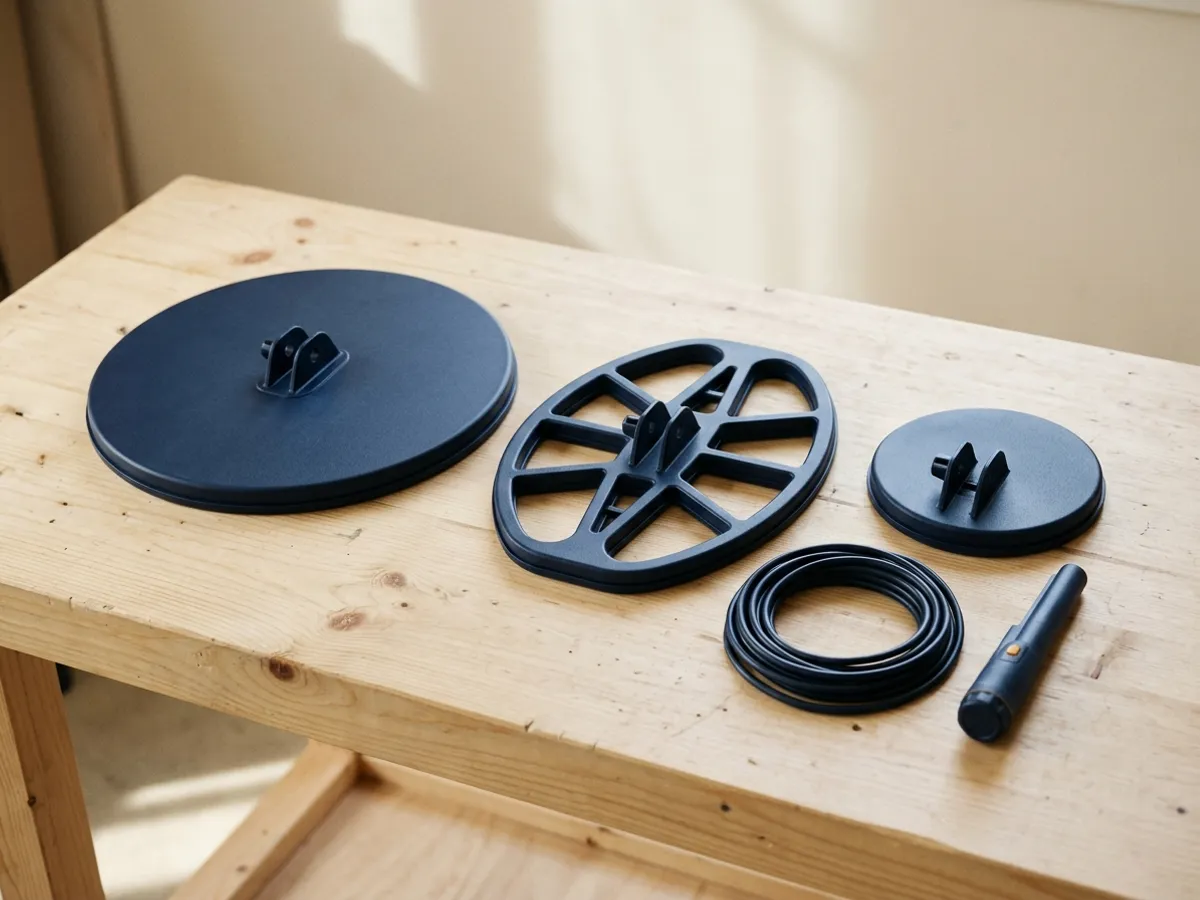
Size matters too. According to Minelab, larger coils reach deeper but are less sensitive to small targets, while smaller coils are more sensitive, lighter and easier to work around rocks and brush.
Ground balance
Soil is not neutral. Garrett explains that iron particles, clay minerals, hot rocks, salt and black sand all send back weak signals that can drown out a small target. Ground balance tells the detector to ignore them. Garrett lists four approaches:
| Type | What it does | Example |
|---|---|---|
| Preset | Set at the factory for average soils, no adjustment | Garrett ACE 300; Tracker IV per the First Texas spec table |
| Automatic | The detector samples the ground and adjusts itself | Vanquish 340 (no user setting) |
| Manual | You adjust it until the ground goes quiet | X-Terra Pro (also offers auto) |
| Tracking | Adjusts continuously as the soil changes | X-Terra Pro |
Note that First Texas is not consistent on the Tracker IV: its spec table says preset, while its product description says automatic. Garrett adds that a fixed setting can struggle in salty coastal sand, and that you should re-balance when moving from a dry field to wet sand.
Pinpointing
In their normal search modes, many detectors respond only while the coil is moving. Pinpoint mode, which Garrett describes on the ACE 300 as a non-motion all-metal mode, lets you hold the coil still and narrow down the exact spot before you dig. Many hobbyists add a handheld pinpointer probe for the last few inches.
Waterproof coil or submersible detector?
"Waterproof" on a box can mean two very different things. A waterproof coil can go in puddles or the surf's edge, but the control box must stay dry: that is the case for the ACE 300 and Tracker IV, and Minelab rates the Vanquish 340 coil to 1 m (3.3 ft). A submersible detector, like the X-Terra Pro (IP68, to 5 m or 16 ft according to Minelab), can go underwater entirely, control box included.
Glossary and the settings to learn first
| Term | What it means |
|---|---|
| VLF | Very low frequency: a common hobby detector design, used by models such as the Tracker IV |
| kHz | Kilohertz, how fast the field cycles; lower reaches deeper on big targets, higher picks up small ones |
| Multi-IQ | Minelab's name for its simultaneous multi-frequency technology |
| Target ID | A number or zone that estimates what a target is |
| Ferrous | Containing iron; Minelab shows it as negative IDs |
| Discrimination | Ignoring targets in chosen ID ranges |
| Notch | Rejecting one narrow ID band while accepting others |
| Iron Resolution | Garrett's finer control over iron rejection |
| Sensitivity | How strong a signal must be to trigger a response |
| Ground balance | Filtering out the signal from minerals in the soil |
| Concentric coil | Inner and outer winding, cone-shaped field, precise pinpointing |
| Double-D coil | Two D-shaped windings, blade-shaped field, steadier in mineralized ground |
| Pinpoint | Non-motion mode to locate a target's exact position |
| Submersible | The whole detector can go underwater, not just the coil |
Which settings to learn first
- Volume and sensitivity. Turn sensitivity down if the detector keeps giving false signals. Garrett's comparison is useful here: sensitivity does not fix ground noise, ground balance does.
- Ground balance. If your detector lets you set it, learn it before anything else, and redo it when the soil changes.
- Iron discrimination. Start with the factory setting and learn how iron sounds before rejecting more.
- Pinpoint. It saves holes and time on every target.
- Notch. Leave it alone until you know your local trash.
- Frequency. Only on selectable machines: start with the maker's mode presets.
For where to put all this into practice, read our guide on where you can legally metal detect. To compare models side by side, see the best metal detectors page.
Frequently asked questions
According to Minelab, lower frequencies, roughly 5 to 10 kHz, suit large, highly conductive targets such as silver coins. Most beginner coin detectors sit in that range, such as the Tracker IV at 6.6 kHz and the ACE 300 at 8 kHz.

Our guides rely on published sources: studies, official bodies, hobby clubs and manufacturer documentation.
- Minelab: Frequently Asked Questions (frequency, discrimination, coils)
- Minelab: How Detectors Work (Multi-IQ)
- Minelab: How to Choose the Ideal Frequency for Your Metal Detector
- Minelab: VANQUISH 340 product page and X-TERRA PRO tech specs
- Garrett: ACE 300 product page
- Garrett: Ground Balance Explained
- Garrett: Multi-Frequency Detector Uses
- First Texas Products: Bounty Hunter Tracker IV product page